
UNDERSTAND INCLUSION AND EMERGING CHANGE
Understand who is included, who may be left behind and what is changing.
People do not experience programs, services, markets and technologies in the same way. Access, participation, opportunity and outcomes can differ across population groups, while social and technological changes can create new opportunities as well as new barriers.
ClerkMaster’s research helps organizations understand exclusion, inequality, access, participation and the ways social and technological change affect different populations.
INCLUSION AND CHANGE
Participation is not the same for everyone.
People may encounter different levels of access, participation, opportunity and barriers depending on their circumstances.
Gender, socioeconomic conditions, geography, vulnerability, digital access, technology adoption and other characteristics can shape people’s experiences and opportunities.
At the same time, social and technological change can alter how people access information, services, platforms and opportunities.
Research helps organizations understand these differences and identify where exclusion or barriers may exist.
WHAT THIS RESEARCH HELPS ORGANIZATIONS UNDERSTAND
Look beyond averages. Understand differences between people and groups.
GENDER, EQUITY AND SOCIAL INCLUSION
How do experiences and outcomes differ across population groups?
GESI Studies examine differences in:
- Access
- Participation
- Benefits
- Agency
- Decision-making
- Barriers
- Program outcomes
across population groups.
GENDER ASSESSMENTS
How do gender roles, norms and power relations affect participation?
Gender Assessments investigate:
- Gender roles
- Gender norms
- Power relations
- Access to resources
- Differential program effects
SOCIAL INCLUSION AND VULNERABILITY
Who may be experiencing exclusion, and what barriers are behind it?
Social Inclusion & Vulnerability Assessments identify populations experiencing exclusion and examine the:
- Economic barriers
- Social barriers
- Institutional barriers
- Physical barriers
underlying that exclusion.
DIGITAL INCLUSION
Who has access to the tools and conditions needed to participate digitally?
Digital Inclusion Studies examine:
- Access to devices
- Connectivity
- Affordability
- Digital literacy
- Barriers to meaningful participation in digital services
TECHNOLOGY ADOPTION
What determines whether people adopt and continue using new technologies?
Technology Adoption Studies assess:
- Awareness
- Trial
- Uptake
- Usage
- Barriers
- Trust
- Sustained adoption
of new technologies and digitally enabled services.
DIGITAL BEHAVIOUR
How are people interacting with digital platforms, information and services?
Digital Behaviour Studies examine how different populations interact with digital platforms, information and services and how these behaviours influence program outcomes.
UNDERSTANDING DIFFERENCE
The average can hide the people who are being left behind.
Overall results may not reveal how different groups experience the same program, service or opportunity.
Disaggregating evidence helps organizations examine differences across relevant population groups and understand where access, participation, barriers or outcomes may vary.
GENDER, EQUITY AND SOCIAL INCLUSION
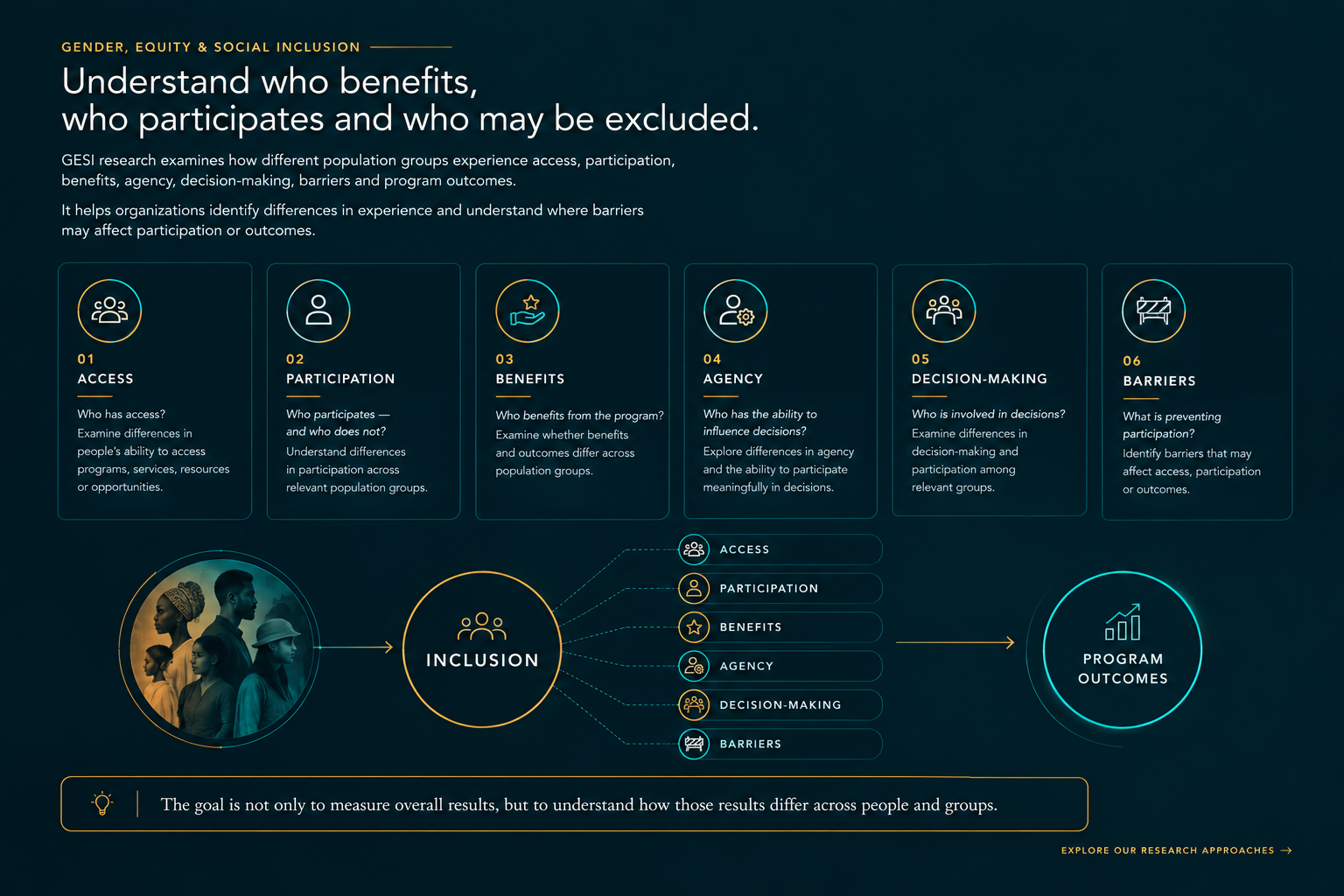
Understand who benefits, who participates and who may be excluded.
GESI research examines differences in access, participation, benefits, agency, decision-making, barriers and program outcomes across population groups.
GENDER ASSESSMENTS
Understand how gender roles, norms and power shape experience.
Gender can influence how people access resources, participate in programs and experience their effects.
Gender Assessments examine the roles, norms, power relations and access to resources that can shape these experiences, including how program effects may differ across groups.
Understanding gender is not only about identifying differences. It is about understanding the conditions that shape those differences.
GENDER ROLES
What roles do people occupy?
Examine the roles people perform within households, communities, institutions and other settings where relevant to the research question.
GENDER NORMS
What expectations shape behaviour?
Explore social norms and expectations that may influence participation, behaviour and decision-making.
POWER RELATIONS
Who has influence and decision-making power?
Examine differences in power and decision-making between relevant groups.
ACCESS TO RESOURCES
Who can access the resources they need?
Explore differences in access to relevant resources and how this may affect participation or outcomes.
SOCIAL INCLUSION AND VULNERABILITY
Understand the barriers behind exclusion.
Not everyone experiences the same program, service or opportunity in the same way.
Social Inclusion & Vulnerability Assessments identify populations experiencing exclusion and examine the economic, social, institutional and physical barriers underlying that exclusion.
To understand exclusion, you first need to understand the barriers creating it.
ECONOMIC BARRIERS
What economic conditions limit participation?
Identify economic factors that may affect people’s ability to access or participate.
social barrierS
How do social conditions affect participation?
Explore social circumstances and barriers that may affect inclusion.
INSTITUTION BARRIERS
How do institutions affect access and participation?
Examine institutional conditions that may create barriers for particular populations.
PHYSICAL BARRIERS
What physical conditions limit access?
Identify physical barriers that may affect participation or access.
DIGITAL INCLUSION
Access to technology does not automatically mean meaningful participation.
Digital participation depends on more than having access to a device.
Digital Inclusion Studies examine access to devices, connectivity, affordability and digital literacy, alongside the barriers that may affect meaningful participation in digital services.
Digital access is only one part of digital inclusion.
DEVICES
Do people have access to the devices they need?
Examine access to relevant digital devices.
CONNECTIVITY
Can people connect?
Understand connectivity and access to digital networks.
AFFORDABILITY
Can people afford to participate?
Examine affordability as a factor affecting digital participation.
DIGITAL LITERACY
Do people have the skills they need?
Assess digital literacy and its relationship with participation.
MEANINGFUL PARTICIPATION
Can people actually use digital services meaningfully?
Understand barriers that may prevent effective participation in digital services.
TECHNOLOGY ADOPTION
What makes people try, use and continue using new technology?
A technology can be available without being adopted.
Technology Adoption Studies assess awareness, trial, uptake, usage, barriers, trust and sustained adoption of new technologies and digitally enabled services.
Understanding adoption means understanding what happens before, during and after first use.
01
AWARENESS
Measure awareness of new technologies or digitally enabled services.
02
TRIAL
Explore whether people move from awareness to initial use.
03
UPTAKE
Understand patterns of uptake among relevant populations.
04
USAGE
Examine use of the technology or digitally enabled service.
05
SUSTAINED ADOPTION
Understand the factors associated with continued adoption.
RESEARCH METHODS
Different inclusion questions require different kinds of evidence.
DISAGGREGATED QUANTITATIVE SURVEYS
See how indicators differ between population groups.
Generate comparable indicators by:
- Gender
- Age
- Geography
- Socioeconomic status
- Other relevant groups
FGDs & IDIs
Explore experiences, barriers and power relationships in depth.
Explore:
- Inclusion
- Exclusion
- Social norms
- Barriers
- Power relationships
PARTICIPATORY RESEARCH
Give affected groups a direct role in identifying barriers and solutions.
Engage affected or marginalised groups directly in identifying barriers and potential solutions.
ETHNOGRAPHIC RESEARCH
Understand how social and technological factors operate in everyday life.
Provide contextual understanding of how social and technological factors operate in people’s everyday lives.
DIGITAL USAGE & ACCESS SURVEYS
Measure access, skills, affordability and adoption.
Quantify:
- Device ownership
- Connectivity
- Digital skills
- Usage
- Affordability
- Adoption
SOCIAL & BEHAVIOURAL SEGMENTATION
Identify groups experiencing different levels of access, vulnerability or adoption.
Identify groups with different levels of:
- Vulnerability
- Readiness
- Access
- Adoption
INTERSECTIONAL ANALYSIS
Understand how multiple characteristics combine to shape experience.
Examine how multiple characteristics combine to create different experiences of opportunity or exclusion.
WHAT QUESTION THIS RESEARCH HELPS ANSWER
What do you need to understand about inclusion and change?
ACCESS
Who has access and who does not?
PARTICIPATION
Who is participating, and who may be left out?
BARRIERS
What is preventing meaningful participation?
DIFFERENCE
How do experiences differ between population groups?
GENDER
How do gender roles, norms and power relations affect participation?
DIGITAL
Who has access to devices, connectivity and digital services?
ADOPTION
What influences whether people adopt new technologies?
CHANGE
How are social and technological changes affecting participation?
Inclusion starts with understanding who is experiencing what and why.
ClerkMaster helps organizations examine access, participation, barriers, vulnerability, technology adoption and changing social and digital behaviours across relevant populations.
Who is being left out and what is changing?
Let’s build the evidence needed to understand differences in access, participation, experience and adoption.