
INFORM PROGRAMS AND POLICY
Evidence for better programs and policy decisions.
Good programs and policies begin with a clear understanding of the problem, the people affected, the environment in which change needs to happen and the options available. ClerkMaster’s research helps organizations generate evidence for program design, policy decisions, advocacy and resource allocation.
EVIDENCE FOR DECISION MAKING
Before designing a program or policy, understand the problem you are trying to solve.
Organizations often need to make important decisions before an intervention begins.
They may need to understand the scale and nature of a problem, identify who is affected, assess existing resources, determine whether a proposed intervention is feasible, understand policy and regulatory conditions, or identify how stakeholders view an issue.
Research can provide the evidence needed to inform those decisions.
ClerkMaster’s Inform Programs & Policy research focuses on generating evidence for better program design, policy decisions, advocacy and resource allocation.
WHAT THIS RESEARCH HELPS ORGANIZATIONS UNDERSTAND
Understand the problem before deciding what to do about it.
POLICY AND REGULATORY ENVIRONMENT
What do existing policies, regulations and institutional frameworks mean for the people and programs involved?
Policy Analysis & Policy Research examines:
- Policies
- Regulations
- Institutional frameworks
- Their implications for programs
- Their implications for populations
- Their implications for markets
NEEDS AND SITUATION
Who needs what, how significant is the problem, and where are the gaps?
Needs Assessments & Situation Analysis examine:
- Who needs what
- Magnitude of the problem
- Nature of the problem
- Existing resources
- Priority intervention gaps
FEASIBILITY
Is the proposed intervention relevant, acceptable, feasible and sustainable?
Program Feasibility Studies assess whether proposed interventions are:
- Relevant
- Acceptable
- Operationally feasible
- Sustainable
before major investment.
FORMATIVE UNDERSTANDING
What do we need to understand before designing the intervention?
Formative Research generates evidence during program design to understand:
- Audiences
- Context
- Barriers
- Appropriate intervention approaches
PROGRAM DESIGN AND THEORY OF CHANGE
How is the intervention expected to create change?
Program Design & Theory of Change Studies establish:
- Causal pathways
- Assumptions
- Intervention logic
- Results chains
- Indicators
ADVOCACY
What evidence can strengthen policy engagement and advocacy?
Advocacy Research generates credible evidence for:
- Policy engagement
- Advocacy messaging
- Stakeholder mobilisation
NEEDS ASSESSMENT AND SITUATION ANALYSIS
Who needs what and where are the gaps?
01
WHO?
Who is affected?
02
WHAT?
What do they need?
03
HOW MUCH?
What is the scale and nature of the problem?
04
WHAT IS MISSING?
Where are the intervention gaps?
POLICY AND REGULATORY ANALYSIS
Understand the policy environment before acting within it.
Policy and regulatory environments can shape programs, populations and markets. Policy Analysis & Policy Research examines policies, regulations and institutional frameworks and their implications for programs, populations and markets.
POLICY
What does the policy say?
IMPLEMENTATION
How is it being applied?
IMPLEMENTATION
What does it mean for the people, programs or markets involved?
PROGRAMS FEASIBILITY
Before major investment, understand whether the intervention can work in its intended context.
Program Feasibility Studies help determine whether proposed interventions are:
- Relevant
- Acceptable
- Operationally feasible
- Sustainable
before major investment.
FORMATIVE RESEARCH
Design the intervention around the people and context it is intended to serve.
Formative Research generates evidence during program design to understand audiences, context, barriers and appropriate intervention approaches.
AUDIENCE
CONTEXT
BARRIERS
INTERVENTION APPROACH
PROGRAM DESIGN AND THEORY OF CHANGE
Make the pathway from intervention to impact clear.
Program Design & Theory of Change Studies establish the causal pathways, assumptions, intervention logic, results chains and indicators underlying a program.
ADVOCACY RESEARCH
Turn evidence into credible support for policy engagement.
Advocacy Research generates credible evidence that can support:
- Policy engagement
- Advocacy messaging
- Stakeholder mobilisation
EVIDENCE
MESSAGE
ENGAGEMENT
MOBILISATION
WHAT QUESTION THIS RESEARCH HELPS ANSWER
What do you need to know before making the decision?
NEED
What problem are we actually trying to address?
PEOPLE
Who is affected, and what do they need?
CONTEXT
What social, economic, institutional or market conditions shape the issue?
POLICY
What policies and regulations affect the situation?
FEASIBILITY
Is the proposed intervention relevant, acceptable and feasible?
DESIGN
What intervention approach is appropriate for this context?
LOGIC
How is the proposed intervention expected to create change?
ADVOCACY
What evidence is needed to strengthen engagement and influence?
HOW WE INVESTIGATE
Different decisions require different evidence.
DESK / LITERATURE REVIEW
What does existing evidence already tell us?
Synthesise existing policies, research, administrative information and program evidence.
POLICY AND REGULATORY ANALYSIS
What do policies, regulations and provisions mean in practice?
Systematically examine legislation, regulations, policy provisions, implementation gaps and implications.
KIIs / EXPERT INTERVIEWS
What do policymakers, implementers and specialists know?
Obtain evidence from policymakers, implementers, specialists and institutional decision-makers.
FGDs & COMMUNITY CONSULTATIONS
How do beneficiaries and communities view the issue?
Capture community and beneficiary perspectives on policies, programs and unmet needs.
PARTICIPATORY RESEARCH
How can affected populations contribute to identifying the problem and solutions?
Enable affected populations and stakeholders to contribute directly to problem identification and solution development.
THEORY OF CHANGE WORKSHOPS
What pathway connects the intervention to the intended outcomes?
Facilitate stakeholder development or validation of program pathways, assumptions and intended outcomes.
SCENARIO ANALYSIS
What could different program or policy options mean?
Assess alternative program or policy options and their likely implications.
WHEN TO USE EACH APPROACH
Start with the question. Then choose the evidence.
QUESTION
- What is already known?
- What is the policy environment?
- What do experts and decision-makers think?
- What do communities and beneficiaries think?
- What do affected populations identify as priorities?
- How should the intervention create change?
- What could different options mean?
POTENTIAL APPROACH
- Desk / Literature Review
- Policy & Regulatory Analysis
- KIIs / Expert Interviews
- FGDs & Community Consultations
- Participatory Research
- Theory of Change Workshops
- Scenario Analysis
FROM PROBLEM TO PROGRAM DESIGN
Move from understanding the problem to defining the response.
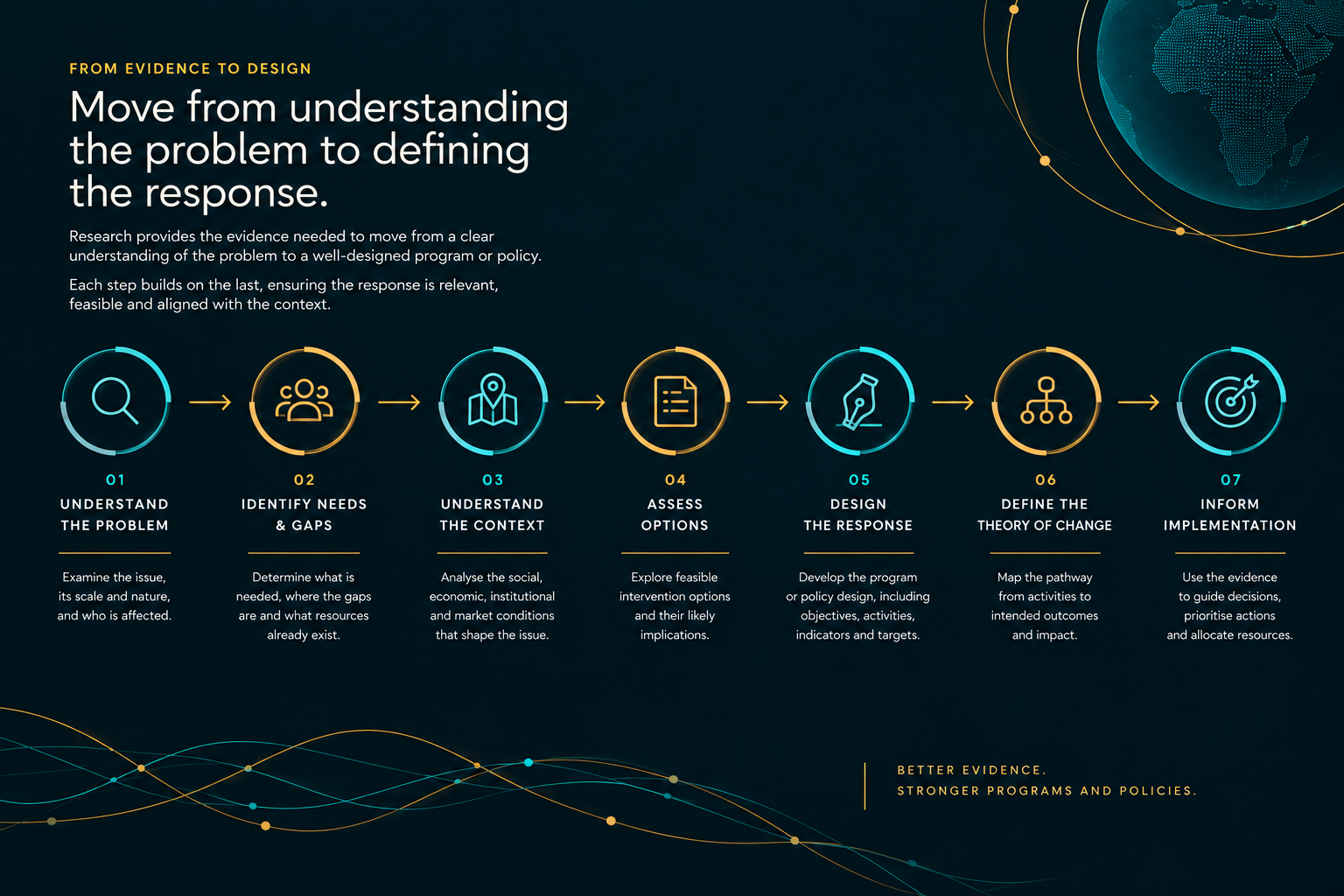
Better programs and policy decisions begin with better evidence.
ClerkMaster helps organizations understand needs, assess feasibility, examine policy and regulatory environments, strengthen program design and generate evidence for advocacy and resource allocation.
What do you need to understand before designing the response?
Let’s identify the evidence needed to understand the problem, assess the options and inform the decision.