
UNDERSTAND PEOPLE
UNDERSTAND WHAT PEOPLE KNOW, EXPERIENCE, BELIEVE, DO AND WHY.
People’s actions are shaped by what they know, what they believe, what they experience, the barriers they face and the factors influencing their decisions. ClerkMaster’s social research helps organisations understand these patterns through structured research that explores knowledge, attitudes, behaviours, experiences, motivations, needs and barriers.
UNDERSTAND PEOPLE.
What people say matters. What they do matters too.
Understanding people often requires looking beyond a single answer. People may know something but not practise it. They may hold a particular belief without acting on it. They may want to change but face social, economic or environmental barriers.
Understanding these differences requires research that explores both what is happening and the reasons behind it.
ClerkMaster’s Understand People research examines knowledge, attitudes, practices, behaviour, public opinion, lived experience, motivations, needs, barriers and readiness to change.
WHAT THIS RESEARCH HELPS ORGANIZATIONS UNDERSTAND
Different questions reveal different dimensions of human behaviour.
KNOWLEDGE, ATTITUDES & PRACTICES
What do people know, believe and actually practise?
KAP studies measure what target populations know, believe and practise, helping identify:
- Knowledge gaps
- Misconceptions
- Knowledge-to-practice gaps
BEHAVIOUR CHANGE
What is driving or preventing behaviour change?
Behaviour Change Studies identify:
- Behavioural drivers
- Barriers
- Motivations
- Social norms
- Incentives
- Environmental factors influencing behaviour and adoption
PUBLIC OPINION
What do people think about programmes, institutions, policies or public issues?
Public Opinion Polling measures:
- Attitudes
- Perceptions
- Priorities
- Trust
- Favourability
- Satisfaction
- Opinion
BENEFICIARY & COMMUNITY EXPERIENCE
How are people experiencing programmes and services?
Explore:
- Lived experiences
- Needs
- Satisfaction
- Barriers
- Perceptions of programmes and services
SOCIAL & BEHAVIOURAL SEGMENTATION
How do different groups differ in behaviour, attitudes and readiness?
Identify population segments according to:
- Behaviour
- Attitudes
- Motivations
- Needs
- Socioeconomic characteristics
- Readiness to change
START WITH THE QUESTION
What do you need to understand about people?
01
KNOWLEDGE
What do people know and what don’t they know?
02
BELIEFS
What do people believe, and what shapes those beliefs?
03
BEHAVIOUR
What are people actually doing?
04
EXPERIENCE
What are people experiencing, and what barriers are they facing?
05
MOTIVATION
Why are people behaving the way they do?
HOW WE INVESTIGATE
Choose the method that matches the question.
QUANTITATIVE SURVEYS
Measure behaviour, attitudes and population characteristics.
Statistically structured measurement of behaviours, attitudes, perceptions and population characteristics
FGDS
Explore shared attitudes, experiences and social norms.
Facilitated group discussions exploring shared attitudes, perceptions, experiences and social norms.
IDIs
Go deeper into individual experiences and motivations.
One-on-one exploration of individual experiences, motivations, barriers and decision-making.
ETHNOGRAPGHY/OBSERVATION
See behaviour in its real setting.
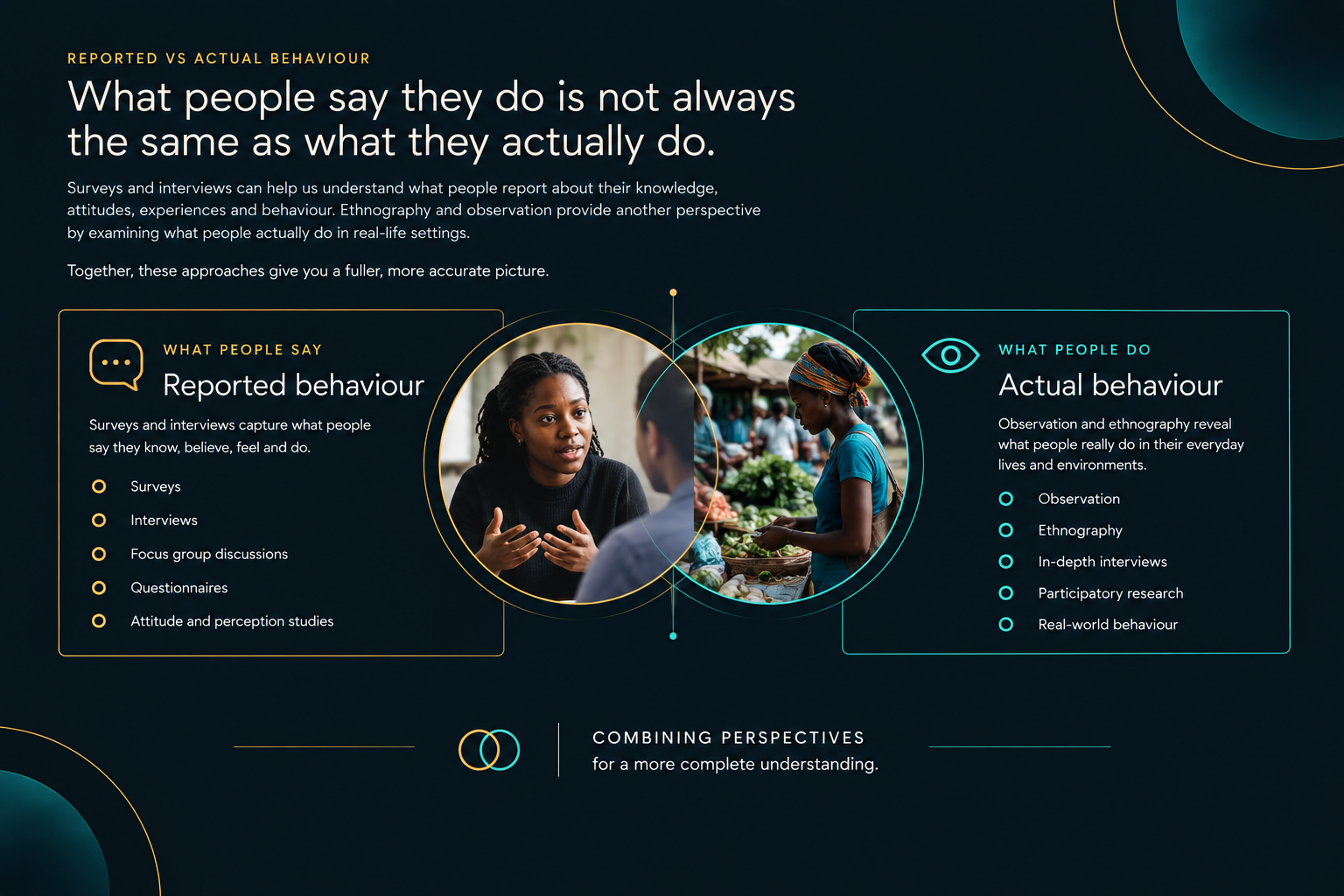
Observe people in real-life settings to understand actual rather than reported behaviour.
PARTICIPATORY RESEARCH
Involve communities in identifying the problem and the solution.
Engage communities directly in identifying and analysing their problems, priorities and solutions.
BEHAVIOURAL DIAGNOSTICS
Understand what is influencing behaviour.
Systematically identify capability, opportunity, motivation and other determinants of behaviour.
UNDERSTANDING REPORTED VERSUS ACTUAL BEHAVIOUR
What people say they do is not always the same as what they actually do.
BEHAVIOUR CHANGE
Understanding behaviour is the first step toward understanding change.
Behaviour Change Studies examine the factors that influence behaviour and adoption.
Research can explore:
Drivers
What encourages behaviour?
Barriers
What prevents behaviour?
Motivations
Why do people act?
Social Norms
How do other people and social expectations influence behaviour?
Incentives
What encourages adoption?
Environment
What external factors influence behaviour?
POPULATION SEGMENTATION
Not everyone experiences a problem in the same way.
Social and behavioural segmentation identifies population groups with different behaviours, attitudes, motivations, needs, socioeconomic characteristics and levels of readiness to change.
This helps organisations understand differences within a population rather than treating everyone as one group.
PARTICIPATORY RESEARCH
Research with people, not simply about people.
Participatory Research engages communities directly in identifying and analysing their problems, priorities and solutions.
It creates space for affected communities to contribute directly to the research process and to the identification of potential solutions.
WHAT THIS RESEARCH CAN REVEAL
Go beyond knowing what is happening. Understand the factors behind it.
WHAT PEOPLE KNOW
Knowledge, awareness and gaps.
WHAT PEOPLE BELIEVE
Attitudes, perceptions and opinions.
WHAT PEOPLE DO
Practices and observed behaviour.
WHY THEY DO IT
Motivations, barriers, social norms and other determinants.
PEOPLE ARE MORE THAN DATA POINTS
Understanding people requires evidence that considers what they know, believe, experience and do as well as the motivations, barriers and circumstances that influence behaviour.
What do you need to understand about the people you serve?
ClerkMaster can help you design research that explores knowledge, attitudes, behaviours, experiences, motivations, needs and barriers.